
The Client Conversation That Changed How I Think About Marketing
Blog post description.
BUSINESS
12/22/20253 min read
There are moments in business that quietly reshape everything. For me, it happened during what seemed like an ordinary discovery call.
A founder sat across from me—tired, overwhelmed, but still hopeful. Their business was growing. Revenue was up. The team was expanding. But something was off.
Then they said it:
"We don't need more posts or ads. We need someone who can make sense of everything."
I stopped mid-conversation.
That single sentence didn't just describe their problem. It exposed a truth I'd been dancing around for years without naming it.
The Marketing Paradox
Most businesses today aren't suffering from a lack of marketing. They're drowning in it.
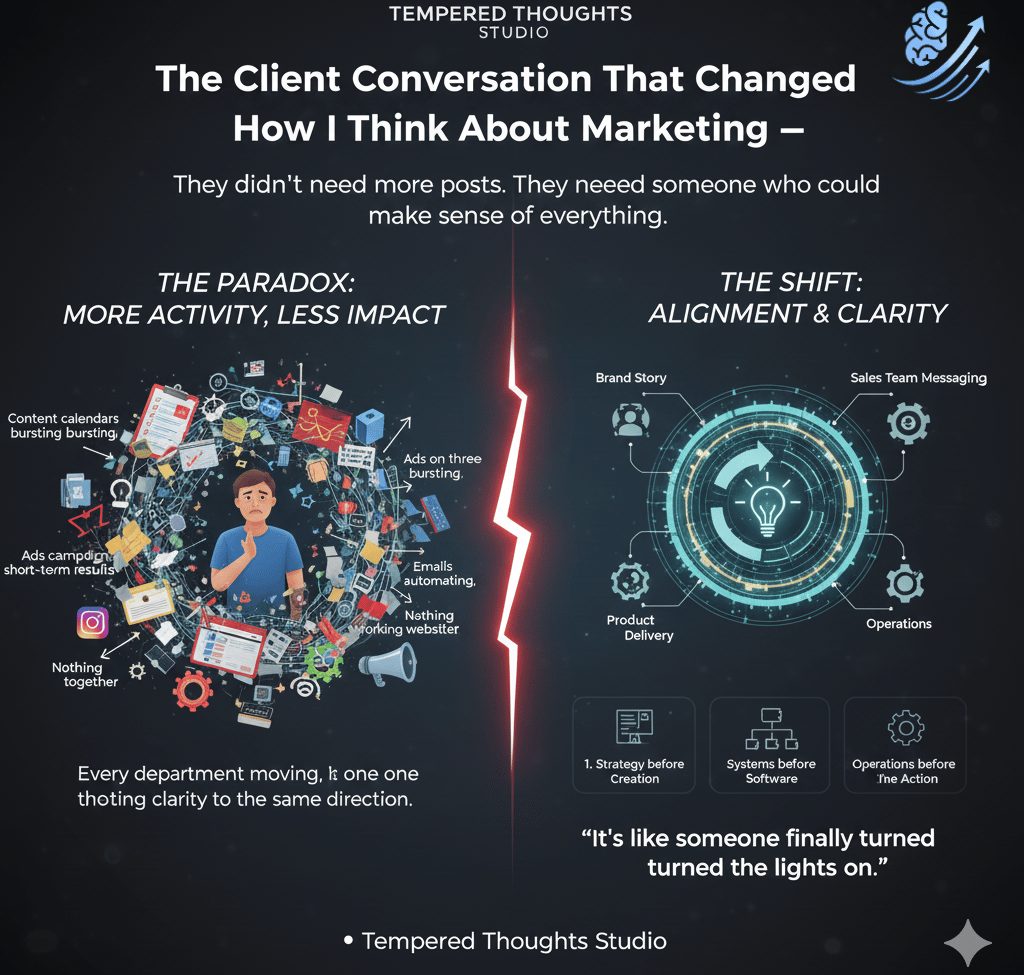
They have content calendars bursting with posts. Ad campaigns running across three platforms. Email sequences automating in the background. Vendors handling different pieces. Tools stacked on top of tools.
And yet, nothing feels like it's working together.
The Instagram content doesn't match the website messaging. The sales team doesn't know what marketing promised. The ads attract people, but the landing page confuses them. Every department is moving, but no one's moving in the same direction.
This is the paradox: more activity, less impact.
What's Actually Missing
That founder wasn't asking for another tactic. They weren't looking for the next growth hack or viral strategy.
They needed alignment.
They needed their brand story to match what their sales team was saying. They needed their marketing message to reflect what their product actually delivered. They needed their operations to support what their campaigns promised.
In short, they needed a system—not just more content.
And that's when it hit me: marketing isn't about doing more. It's about bringing clarity to the chaos.
The Shift That Changed Everything
That conversation became the turning point for how I built Tempered Thoughts Studio.
I stopped chasing the industry narrative that "more is better." I stopped selling businesses on volume and vanity metrics. Instead, I started asking different questions:
What are you actually trying to say?
Who needs to hear it?
Does everything you're doing support that message?
Where are the gaps between what you promise and what you deliver?
These aren't marketing questions. They're alignment questions.
And alignment is where real growth happens.
Strategy Before Creation. Systems Before Software.
This realization led to three core principles that now guide every project we take on:
1. Strategy before creation
Before we write a single post or design a campaign, we get clear on the foundation. What's the brand positioning? What's the core message? Who's the right audience? Without this, everything else is just noise.
2. Systems before software
Tools are only useful if you have a process to support them. We focus on building workflows and systems that connect marketing, sales, and operations—so nothing exists in a silo.
3. Alignment before action
Moving fast only matters if you're moving in the right direction. We make sure every piece of content, every campaign, every touchpoint serves the same strategic goal.
This isn't about perfection. It's about coherence.
What Alignment Actually Looks Like
When a business achieves alignment, everything shifts.
The founder finally feels like their brand represents who they are. The sales team closes more deals because marketing set the right expectations. The customer experience feels seamless because operations deliver what was promised.
Marketing stops being a cost center and becomes a growth engine—not because you're spending more, but because everything is working together.
One founder described it this way: "It's like someone finally turned the lights on."
One Honest Sentence. A Whole New Direction.
I think about that conversation often.
Not because it was dramatic or revolutionary on the surface, but because it forced me to confront an uncomfortable truth: I had been part of the problem.
For years, I was selling businesses what they thought they needed—more content, more ads, more visibility. But what they actually needed was someone to help them connect the dots.
That one sentence—"We need someone who can make sense of everything"—didn't just change how I think about marketing.
It changed the entire foundation of my business.
If you're feeling overwhelmed by all the marketing you're doing but not seeing the results you expected, the problem might not be that you're doing too little. It might be that you're doing too much—without a system to hold it all together.
Sometimes, the most powerful marketing move isn't adding something new.
It's bringing clarity to what's already there.
Growth
Unlocking potential through strategic business solutions.
Consulting
Innovation
info@deepanshunandwani.in
+91 93500 37794
© 2025. All rights reserved.