
What Running Tempered Thoughts Taught Me About My Own Mental Models.
Blog post description.
BUSINESS
12/11/20254 min read
What Running Tempered Thoughts Taught Me About My Own Mental Models.
There's a version of entrepreneurship that gets celebrated everywhere: the hustle, the grind, the overnight success stories.
Then there's the version no one talks about: the internal transformation that happens when you're forced to confront your own thinking patterns every single day.
Running Tempered Thoughts Studio didn't just change how I work. It fundamentally changed how I think.
And I've realized something crucial: my real growth didn't come from learning new tactics or tools. It came from upgrading my mental models—the invisible frameworks that shape every decision, strategy, and outcome in my business.
Here are the three biggest lessons that transformed not just my studio, but my entire approach to building anything meaningful.
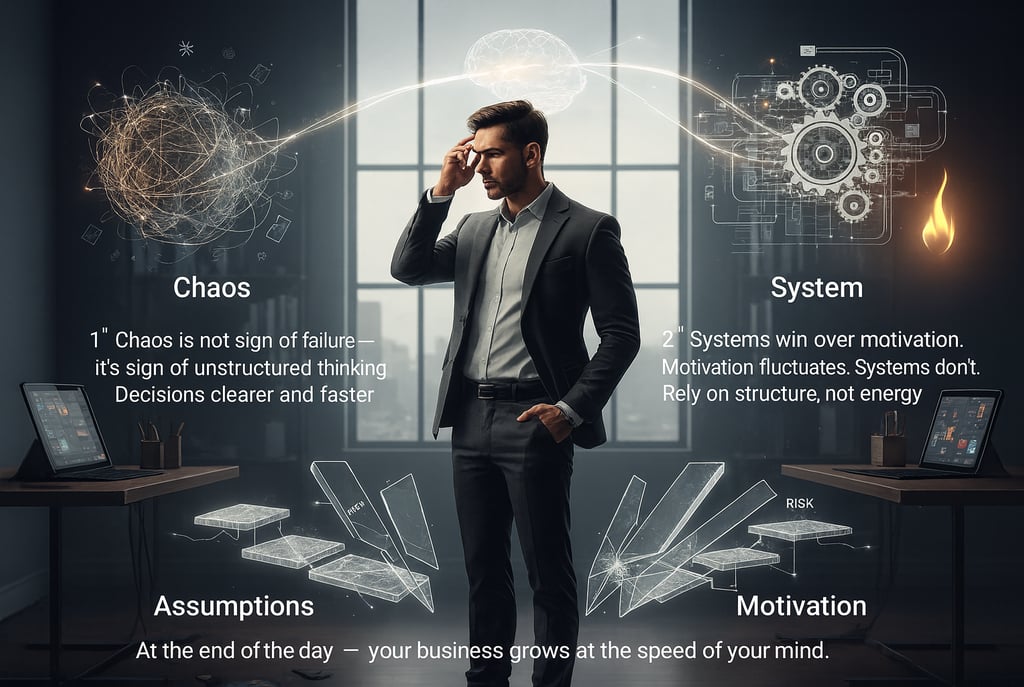
1. Chaos Is Not a Sign of Failure—It's a Sign of Unstructured Thinking
For the longest time, I thought chaos was just part of the entrepreneurial journey.
Messy schedules. Competing priorities. A million ideas pulling me in different directions. Tasks that felt urgent but led nowhere. Decisions that took forever because nothing felt clear.
I told myself this was normal. That I just needed to work harder, stay more focused, push through.
But here's what I discovered: chaos isn't caused by external circumstances. It's caused by unstructured thinking.
When my thoughts were scattered, my business was scattered. When I couldn't articulate what mattered most, everything felt equally important—which meant nothing actually got done.
The breakthrough came when I learned to temper my thoughts.
Not suppress them. Not ignore them. But organize them.
I started asking better questions:
What problem am I actually trying to solve right now?
What's the clearest path to that outcome?
What can I eliminate or defer?
Once I learned to structure my thinking, decisions became clearer and faster. The chaos didn't disappear, but my ability to navigate it completely transformed.
The lesson: Chaos is feedback. It's telling you that your thinking needs structure, not that you're failing.
2. Systems Win Over Motivation Every Single Time
Here's an uncomfortable truth I had to accept: motivation is unreliable.
Some days, I'd wake up energized and ready to conquer the world. Other days, I could barely answer emails.
Initially, I tried to solve this with productivity hacks, morning routines, and motivational content. But none of it worked long-term because I was relying on energy instead of structure.
That's when I shifted everything.
I stopped asking, "How do I stay motivated?" and started asking, "How do I build systems that work even when I'm not motivated?"
Building the Flow Management System (FMS) for clients taught me this lesson on a deeper level. A good system doesn't depend on someone's mood, energy, or inspiration. It runs because the structure supports it.
I applied the same thinking to my own business:
Standard operating procedures for recurring tasks
Decision frameworks for common scenarios
Workflows that removed the need to "think" about basic operations
The result? I got more done on low-energy days than I used to on peak-motivation days.
Motivation fluctuates. Systems don't.
The lesson: Build infrastructure that carries you forward, regardless of how you feel. Your business shouldn't collapse every time your energy dips.
3. Assumptions Are the Biggest Bottleneck to Growth
This one hit me the hardest.
Every time my business felt stuck, I'd look for external reasons: the market, the economy, the competition, the algorithm.
But when I got honest with myself, I realized the real bottleneck was always my own assumptions.
I assumed clients wanted one thing, so I kept offering it—until someone asked for something completely different and it became our most successful service.
I assumed a certain approach was "best practice," so I kept following it—until I tested an alternative and saw 10x better results.
I assumed I needed to be in every marketing channel—until I focused on two and finally gained traction.
Every time I questioned a belief I'd been holding as truth, the business unlocked a new level.
Now, I actively hunt for my own assumptions. I ask:
What am I treating as fact that's actually just opinion?
What would I do differently if this belief wasn't true?
What's one thing I'm refusing to try because I've already decided it won't work?
This practice alone has created more breakthroughs than any course or mentor ever could.
The lesson: Your unexamined assumptions are invisible walls. Question them, and you'll find doors you didn't know existed.
Why Mental Models Matter More Than Tactics
Here's what I've come to understand: tactics are temporary. Mental models are foundational.
You can learn a new marketing strategy, a new tool, a new framework—and those things will help. But if your underlying way of thinking is flawed, you'll just apply the new tactic in the same old way and wonder why it didn't work.
I couldn't just "work harder." I had to think better.
I couldn't just "do more marketing." I had to structure my thinking around what actually drives results.
I couldn't just "stay motivated." I had to build systems that worked regardless of my emotional state.
This wasn't about becoming a better marketer. It was about becoming a better thinker.
And that changed everything.
Your Business Grows at the Speed of Your Mind
The most successful entrepreneurs I've met aren't necessarily the smartest or the hardest working.
They're the ones who continuously upgrade how they think.
They notice when their thinking is chaotic—and they fix it.
They stop relying on motivation—and they build systems instead.
They challenge their own assumptions—before those assumptions become limitations.
Running Tempered Thoughts Studio taught me that business growth isn't just about strategy and execution. It's about the quality of thinking that precedes both.
Your revenue ceiling isn't determined by market size or competition. It's determined by the mental models you're operating with.
Your stress level isn't determined by your workload. It's determined by how structured your thinking is.
Your ability to scale isn't determined by hours worked. It's determined by how well you've systematized your operations.
At the end of the day, your business grows at the speed of your mind.
If you want different results, you don't need a new tactic.
You need a new way of thinking.
And that's the real work. The internal work. The work that doesn't show up on a task list but transforms everything you touch.
Because when you upgrade your mental models, you don't just build a better business.
You build a better version of yourself.
And that's the foundation everything else is built on.
Growth
Unlocking potential through strategic business solutions.
Consulting
Innovation
info@deepanshunandwani.in
+91 93500 37794
© 2025. All rights reserved.